
I think it’s fair to say that without Dave Marsh, the trailblazing rock critic who died this past week at the age of 76, there wouldn’t have been an All Music Guide. It’s not that he encouraged or mentored our original editorial team; it’s that the whole project served as something of a corrective to the attitude he cultivated in The Rolling Stone Record Guide.
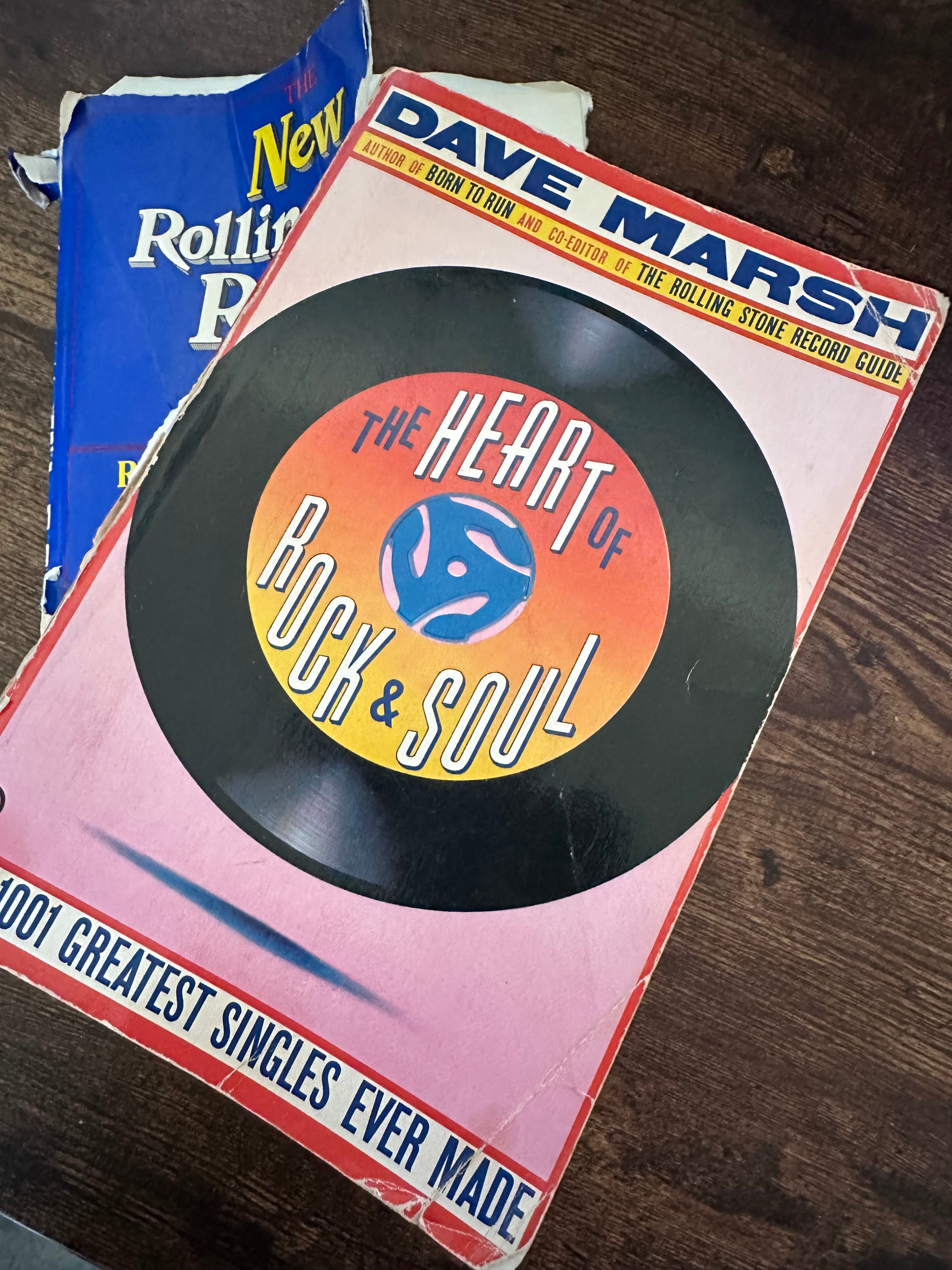
I had spent years poring over The New Rolling Stone Record Guide—the 1983 update with the blue cover, not the 1979 original painted in red (I didn’t find a copy of that until years later)—absorbing its style and opinions before the inception of All Music Guide in late 1991. There are several reasons my uncle Michael started AMG, including his disbelief that I purchased a copy of John Coltrane & Johnny Hartman when there were other, better Coltrane albums out there, but an instigating factor was his frustration at how the book didn’t draw distinctions between albums within a discography. I remember him specifically griping about the ABBA entry, another one of those columns of two-star records punctuated with a three-star hits comp, which wasn’t written by Marsh but sure followed his editorial edict: an entire body of work dismissed in a pithy paragraph.
All Music Guide was designed to provide an arc within a discography—all the peaks and valleys were relative to a specific artist—and to get into the granular details of individual albums. It was a welcome, maybe necessary, shift and the rise of the internet allowed many AMG writers to get into the weeds of an artist’s work. This was all fun and games until it came time to condense a Deep Purple entry from ten or so pages to maybe two, as I had to do the last time we ever published a printed All Music Guide to Rock. Moments like that made me appreciate the ability to succinctly summarize an unwieldy body of work, which Marsh and his writers often did in The New Rolling Stone Record Guide.
Alongside those canonical entries, The Blue Book has dozens of dismissals of musicians who are now forgotten. I opened my copy at random and discovered Marsh’s sentence-long review of Chris Montan’s Any Minute Now: “Writer/singer so slick and tasteful you’ll want to strangle him before you’ve heard a full side.” The wonders of technology mean that it’s now possible to head to YouTube and check out Montan, an artist who never saw a domestic CD reissue of his lone album, and discover that Marsh’s assessment was on the money. Flipping through The Blue Book, it’s a bit of a wonder how much space is devoted to artists and albums that have fallen by the wayside. Although I share Chuck Eddy’s suspicion that Marsh may not have listened to all of the records he dismissed—in his remembrance, Chuck cites the Nazareth entry, where Marsh claims the band’s “biggest claim to fame is a 1975 hit, ‘Love Hurts,’ which bears not a smattering of resemblance to the great Everly Brothers song of the same name,” when it is in fact a cover—part of the appeal of the book is how the greats rub shoulders with ephemera. That’s what popular music is: there are glimmers of brilliance amidst the trash and sometimes the trash glitters, too.
Marsh harbored catholic tastes but he wasn’t particularly interested in cheap thrills. In The Heart of Rock and Soul: The 1001 Greatest Singles Ever Made, he draws a distinction between Aerosmith and their forefathers the Rolling Stones: “Understood in the seventies as a second-rate imitation of the Stones, with a first-rate guitarist offsetting a third-rate front man, Aerosmith may have been somebody’s legit high school faves but there was little danger of mistaking them for artists. Their ambitions didn’t encompass any such thing; they were out for quick, disposable kicks and if you liked them, they delivered.”
He preferred his kicks to have substance and he was adept at arguing why, say, “Nobody But Me” by the Human Beinz, had lasting power. This skill combined with his voracious musical appetites, creates the illusion that The Heart of Rock and Soul covered every conceivable strain of pop, rock, or soul, which it does not. Marsh was blunt about his dislikes and blind spots. In the book’s introduction, he notes, “Progressive rock sounds desiccated to me because it’s so thoroughly divorced from the taproot of rock and roll: rhythm and blues.” That credo could explain his disdain for anything explicitly arty, yet he still fell under the spell of Roxy Music and Peter Gabriel, finding room for no less than three 45s from the former Genesis frontman in his list of 1001 singles.
The length of The Heart of Rock and Soul allows Marsh to indulge in such contradictions but, more importantly, it gives him space to offer context and create unexpected connections between genres and eras. All the canonical artists of the early rock era are here—the Beatles don’t make the Top Ten, but the Rolling Stones, Bob Dylan, Marvin Gaye, Chuck Berry and Aretha Franklin all do—yet it doesn’t feel fussy or staid because Marsh also devotes space to disco, country and hip-hop, adding worthy B-sides and flops alongside cult classics and oldies staples. He also extends the timeline to the brink of his deadline: the last single here is Rob Base & DJ E-Z Rock’s “It Takes Two,” which was released in 1988, months before the book’s 1989 publication.
I read The Heart of Rock & Soul as much as The New Rolling Stone Record Guide, maybe more, but it wasn’t until adulthood that it influenced my critical approach more than The Blue Book. The essential lesson I learned from The Heart is that great records can be found anywhere. They can be buried in the past or cut within the last year. They could be inescapable upon their release or only find an audience years later. This omnivorous ideal powered me and my colleagues at All Music Guide as we built the repository of album reviews and artist biographies that became known as the Allmusic database. Marsh might have felt some kind of kinship with this Michigan crew because he did write for AMG at one point in the 2000s. I can’t recall the particulars outside of his long friendship with Thom Jurek. I do know that he contributed some gospel reviews, plus this cutrate Joe Tex comp that he reviewed for some unknown reason.
I also know that Marsh remains a critic I regularly read. Whenever I’m revisiting an older artist or record, I’ll haul out The New Rolling Stone Record Guide and The Heart of Rock & Soul along with Christgau’s Record Guide because they help me develop my own original thoughts, which is all we can ever ask of a critic.
I recognize the name but hadn't realized what a central role he played in rock criticism. Thanks for giving him the spotlight, this was a great read.
Thanks for your comments on Dave Marsh. I enjoyed reading your views and was a little surprised. As someone who takes music and film criticism seriously, I can appreciate the love/hate relationship it is possible to have with a critic. When I read a Pauline Kael review that felt on target, it always increased my own awareness of the film and usually heightened my enjoyment. But it was devastating when she would trash a film I enjoyed. It was painful. Likewise with music critics, and one of the things I have learned over years of loving music is that critics are going to have opinions, and some of them you won’t like. What I respect is the voice. I respected and sought out the writings of Mr. Marsh, in the same way I seek out your writing, but I have come to understand sometimes our thoughts will diverge, and that’s OK. I still enjoy the insights you and folks like Dave Marsh offer. Thanks.